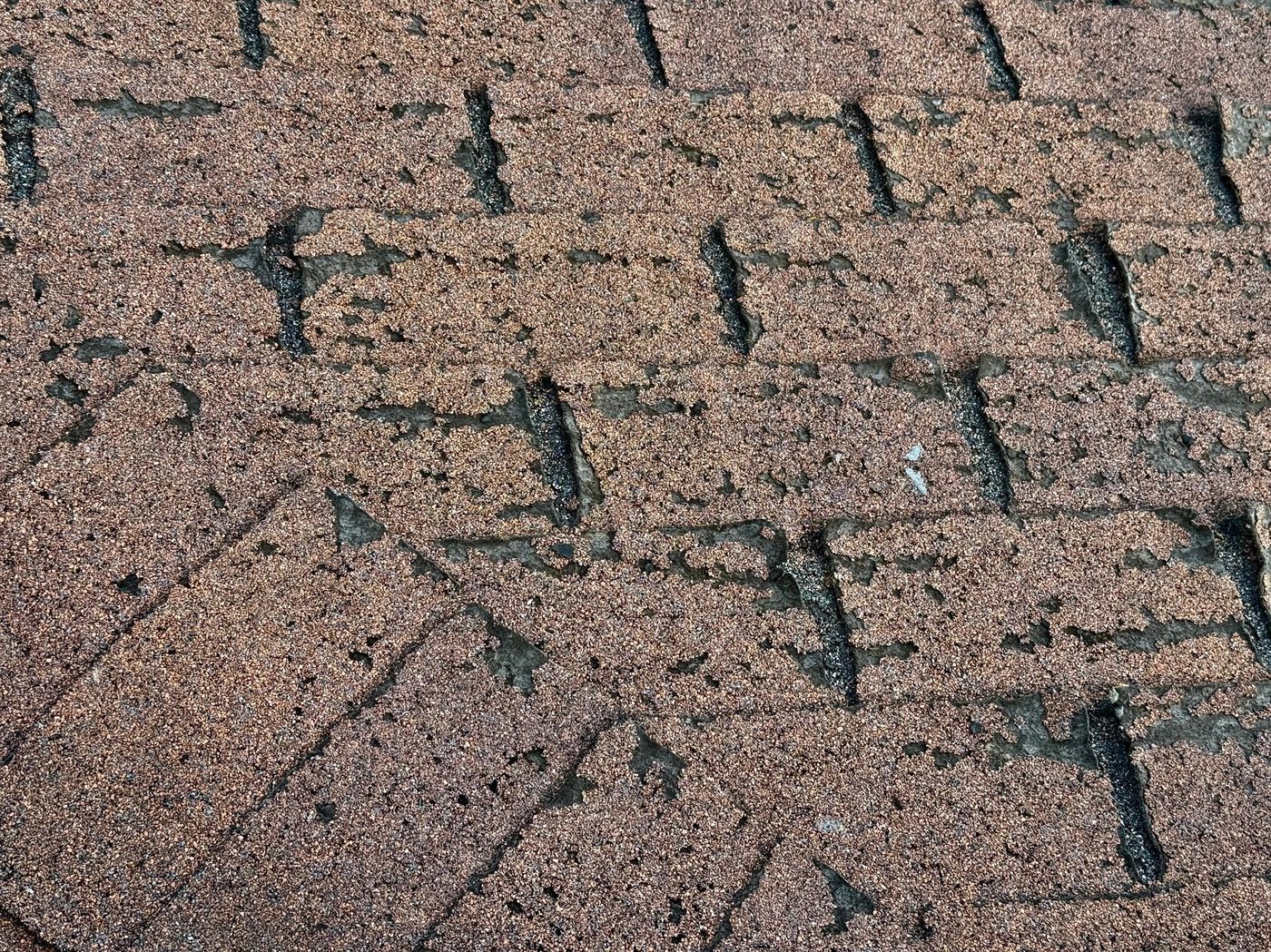
Hail-bruised shingle with granule loss, Watertown WI

Hail Damage

Hail Damage Roof Repair

Hail bruises shingles rather than breaking them. It does not leak right away — it just takes years off the roof. What a hail damage inspection in Watertown and across southern Wisconsin actually finds.

The Inspection

Hail Damage Roof Repair In Watertown: What The Inspection Finds

Hail damage roof repair in Watertown starts with a free inspection of every slope by hand: a hailstone bruises the mat under the granules, the roof looks fine from the ground, and it fails years early. Bruising on every slope means a replacement through your claim; one elevation, a documented partial.

The 2.75-inch hail that fell on Watertown on April 14, 2026 — the storm record — is on a great many roofs in town that show nothing from the street, and the statutory clock on it runs to April 2027.

The Damage

What Hail Damage Looks Like: Bruising, Granule Loss And Mat Fracture

A hailstone hitting asphalt knocks the granules loose and bruises the mat underneath. The granules are the shingle’s sunscreen; without them the asphalt starts to break down. The bruise is a soft spot you can feel with a thumb before you can see it from the ground.

This is why hail damage is so often missed. Nothing leaks. The roof looks broadly fine from the driveway. Then it fails eight years early, long after the twelve months Wis. Stat. § 631.83(1)(a) allows to bring a claim to court has run.

Signs

Signs Of Hail Damage You Can See From The Ground

Dented gutters and downspouts

Soft aluminum takes a visible dent from stones that only bruise a shingle. If the gutters are dimpled, the roof took the same hits.

Granules in the downspout outlets

A handful of black grit where the downspouts drain is shingle surface that is no longer on the roof.

Dented vents, caps and flashing

Metal roof penetrations dent before shingles show anything. They are the most reliable ground-level tell.

Damaged window screens and siding

Screens tear and vinyl siding cracks. Both help establish the direction and size of the hail, and both belong on the same claim.

Split or bruised deck boards

A wooden deck or fence in the same yard records the same storm at eye level.

Air conditioner fins

The condenser unit is a hail gauge sitting in your yard. Flattened fins mean the roof was hit hard.

On The Roof

What The Inspection Finds That You Cannot

Bruising

A soft, circular impact mark where the mat has fractured under intact-looking granules. Found by hand, slope by slope, and photographed with a coin for scale.

The pattern

Dense on the slopes that faced the storm, sparse on the lee. That pattern is what separates hail from wear in an adjuster’s report, and it is why every slope has to be walked.

Granule loss at the mat

Exposed black asphalt in the impact center. The shingle is no longer protected from the sun there and will crack first.

Collateral on the roof

Dented ridge vent, split pipe boots, a cracked skylight seal. Metal and rubber take marks at hail sizes that leave a shingle debatable.

The Delay

Why Hail Damage Is Not Visible Inside The House Until Much Later

A bruised shingle is still a whole shingle. It keeps the rain out for years, which is why a homeowner rarely connects the ceiling stain in the sixth spring with the storm in the first. What has happened in between is that the fractured mat has cracked open a little more each winter under the freeze-thaw cycle, the bare asphalt around the impact has weathered through, and water has finally found the nail below.

By then the twelve months Wis. Stat. § 631.83(1)(a) allows to bring an action on the policy have long gone, and the roof is a replacement you fund. The inspection in the weeks after the storm is what prevents that, and the neighbors’ new roofs are the signal to book it. The claim sequence starts there.

Straight Answers

Hail Damage Questions

The ground-level signs above, yes. The bruising itself, generally not — it takes being on the roof with a hand on the shingle, and the pattern across slopes only appears once every slope has been walked. Please do not climb up to check: hail-damaged shingles are more fragile, granule loss makes them slick, and a roof is not worth a fall. The inspection is free and the photographs are yours to keep.

Roughly one inch is where asphalt shingles start taking functional damage, though older and more brittle shingles bruise at less. Size is not the only factor — wind-driven hail at a shallow angle does more to one slope than to another. For scale, Watertown’s record runs from 0.75-inch stones on several dates to the 2.75-inch hail of April 14, 2026; the storm record lists every dated event by town.

Often yes, because hail is rarely local. If the bruising is across every slope there is nothing to patch, and a replacement is what the claim funds. If one elevation took it and the others are clean, a partial can be legitimate, though many policies and most manufacturers dislike mixing, and an unavailable matching shingle is itself a scope question for the adjuster.

You should get an inspection. Same storm, same street does not mean same damage — the pitch, orientation and age of your roof changed what it caught, and the south and west slopes usually take it worst. What it does mean is that it is worth ten minutes of somebody’s time, and that the storm was large enough to have a record. The FAQ covers what happens if the inspection finds nothing.

Related

More Roofing Services

All roofing services

Replacement, repair, storm work, inspections, ice dams and ventilation, and how they fit together.

Roofing services

The questions we get asked

Cost, timing, permits, insurance and warranties, answered plainly on one page.

Roofing FAQ

Storm damage repair

The whole storm process in one place, with Watertown’s storm record from the National Weather Service.

Storm damage

ACV versus RCV

The setting in your policy that decides whether hail costs you a deductible or most of a new roof.

Depreciation

Free Inspection

Think The Hail Reached Your Roof?

Free inspection, every slope walked by hand, and a dated report with photographs — the document a claim rests on.