How To
Spotting Hail Damage Without a Ladder
Six things you can check from your own yard in five minutes — and the one sign you cannot see without being on the roof.
· Reviewed by Kevin Strauss
The Six
Six Signs Of Hail Damage You Can Spot From The Ground
The signs of hail damage on a roof you can spot from the ground: dented gutters and downspouts, granules at the downspout outlets, dented vents and flashing, torn screens and cracked siding, flattened air-conditioner fins, and dents in a deck or fence. Two or three of the six means someone should walk the roof.
Not you. Hail-damaged shingles are more fragile than sound ones, granule loss makes them slick, and every year somebody falls off a ladder checking a roof a professional would have looked at for free. Everything below is done with your feet on the grass — and it matters this season rather than the year the leak appears, because the clock on a claim runs from the storm.
Checklist
Six Ground-Level Hail Damage Checks
Gutters and downspouts
Soft aluminum dents from hail that only bruises a shingle. Dimpled gutters mean the roof took the same hits, and hail damage on gutters and downspouts is the first thing an adjuster photographs.
Granules at the downspout outlets
A handful of coarse black grit where the water drains is shingle surface that is no longer protecting anything. Fresh loss after a storm looks like sand on the splash block.
Metal vents and flashing
Roof vents, caps and chimney flashing dent before shingles show anything. Binoculars from the lawn are enough to see it. The most reliable single tell.
Window screens and siding
Torn screens and cracked vinyl help establish the size and direction of the hail, and belong on the same claim as the roof.
Air conditioner fins
The condenser in your yard is a free hail gauge. Flattened fins mean it was hard hail, and the side that is flattened tells you which slopes faced it.
Decks and fences
Wood records impacts at eye level. Fresh light-colored dents in a gray deck board are hail marks, and a coin beside one gives the photograph scale.
Under The Surface
What Hail Actually Does To A Shingle
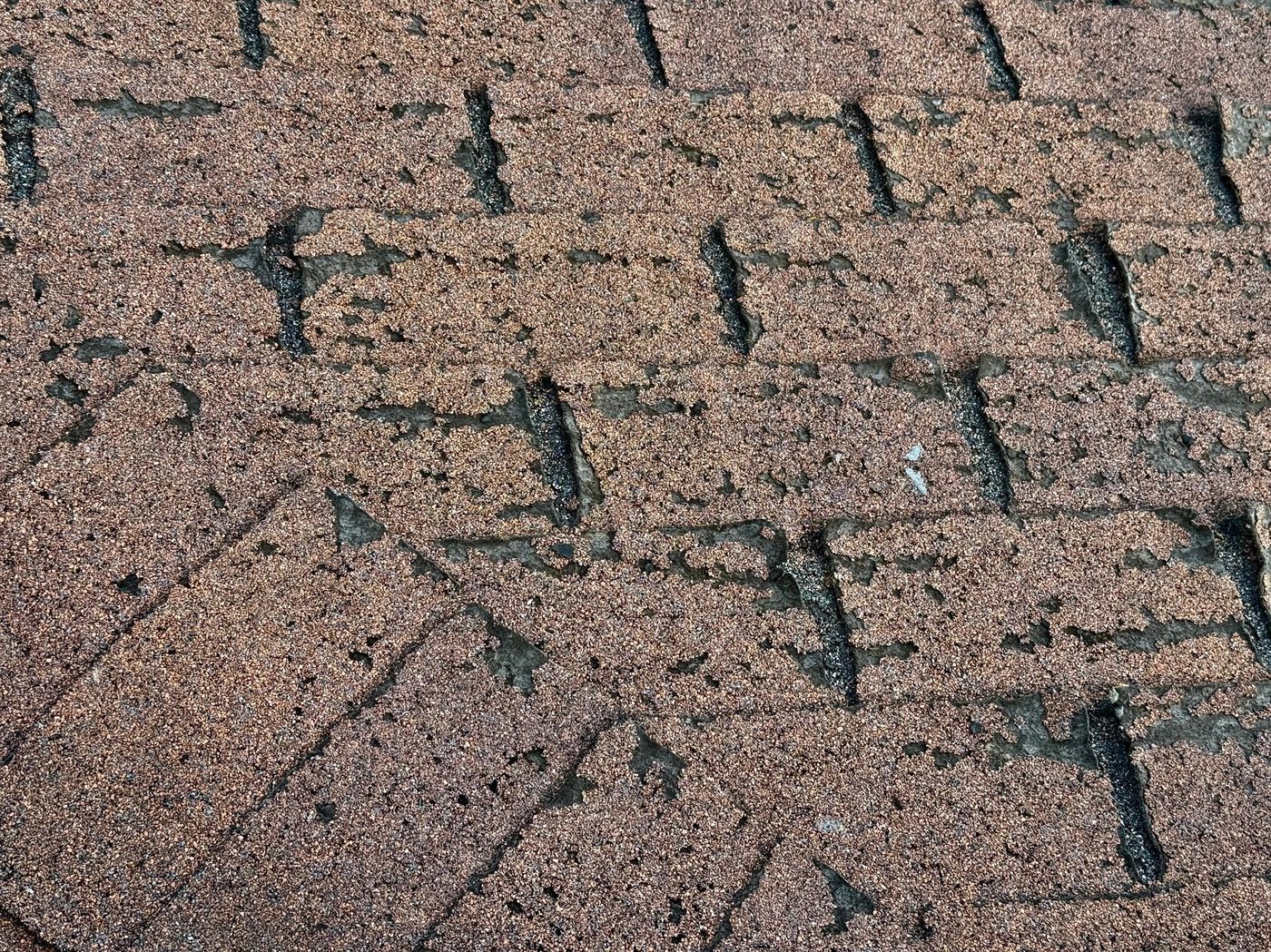
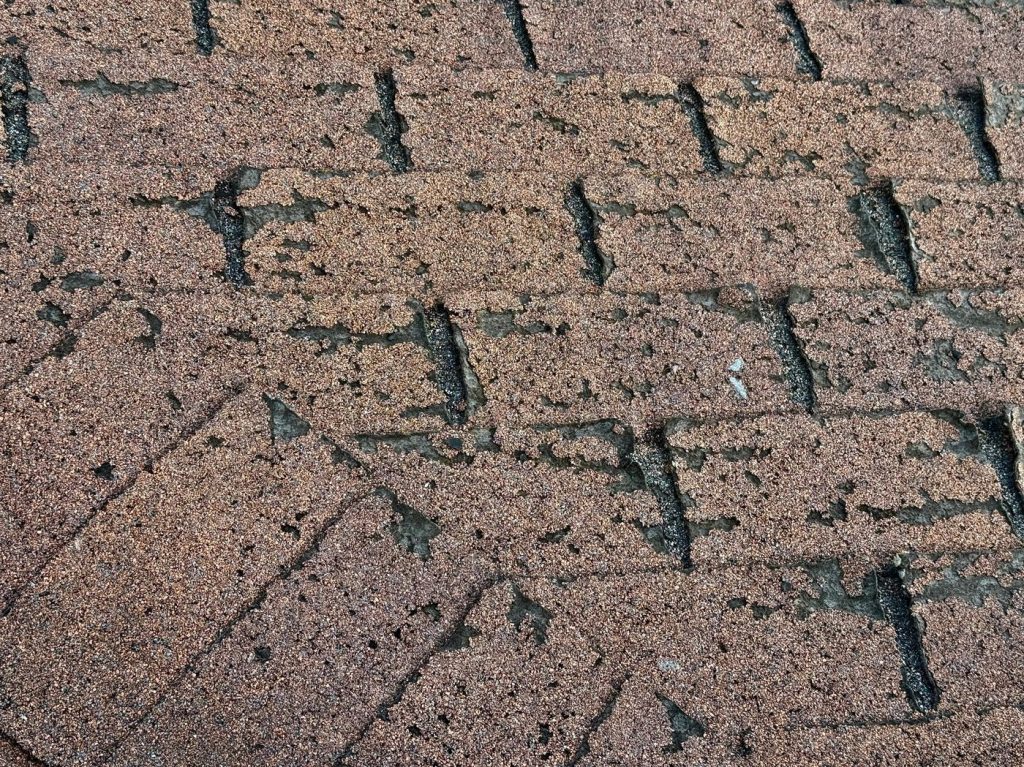
A hailstone hitting asphalt knocks the granules loose and bruises the fiberglass mat underneath. The granules are the shingle’s sunscreen; without them the asphalt oxidizes and cracks. The bruise is a soft spot you can feel with a thumb, often before you can see it, and under it the mat has fractured.
None of that leaks that day. What happens over the following winters is that the fractured mat opens a little further each freeze-thaw cycle, the bare asphalt around the impact weathers through, and water finds the nail below — usually five to eight years on. That is why a roof that “looks fine” after hail can be a total loss on an adjuster’s report, and why the hail damage page spends so long on the pattern rather than the leak.
On Paper
How An Adjuster Reads A Roof
The test square
A ten-by-ten-foot square chalked on each slope, with every impact inside it circled and counted. Most carriers treat eight or more hits in a square as a damaged slope; the threshold is the insurer’s, so ask what theirs is.
The pattern across slopes
Hail rarely hits four slopes equally. Dense on the side that faced the storm, sparse on the lee — that pattern is what separates hail from wear in a report, and why every slope has to be walked.
Collateral damage
Your six ground checks, in the adjuster’s file. Dents on soft metals establish that hail of a damaging size fell at this address on this date, before anyone argues about a shingle.
The storm record
The date matters as much as the damage. The NOAA Storm Events Database carries every recorded hail report by county, and the storm record here has each one by town.
Storm History
What Has Fallen On Watertown
For scale: Watertown’s own hail record from the National Weather Service, newest first. Roughly one inch is where asphalt shingles start taking functional damage; the April 14, 2026 storm brought 2.75-inch stones.
31 recorded storms since 2005 · largest hail 2.75″ · strongest gust 75 mph · NOAA
-
June 10, 2026
Straight-line wind
Full record →An intense complex of thunderstorms tracked across most of southern Wisconsin, northern Illinois, and portions of northeast Wisconsin during the afternoon hours on June 10, 2026. Multiple measured wind gusts of 70+ MPH were reported as the storms moved across southern Wisconsin, resulting in widespread tree & power line damage. Several areas of structural damage…
-
April 14, 2026
Hail
Full record →Numerous severe thunderstorms developed across southern Wisconsin during the afternoon and evening hours as a wave of low pressure moved across a stationary front over the region. Two main supercell thunderstorms developed along and north of Interstate 94 between Madison and Milwaukee, which produced softball sized hail and an EF-2 tornado. These storms would later…
-
April 18, 2025
Hail
Full record →A cluster of severe thunderstorms with very large hail and heavy rain tracked along a warm front over southern WI during the morning. Numerous reports of very large hail were received, and also flash flooding in Milwaukee.
-
April 15, 2023
Hail
Full record →An approaching weak low pressure area and cold front triggered scattered strong storms across southern WI. A couple reports of hail were received.
-
June 13, 2022
Hail
Full record →A supercell thunderstorm formed north of a warm front and tracked east across much of southern WI. A swath of destructive hail and sporadic wind damage occurred. More specifically, vehicle, shingle, siding, gutter, and window screen damage. Short segments of tree damage also occurred. Three people drowned in Milwaukee when two men attempted to help…
-
September 7, 2021
Hail
Full record →A broken line of thunderstorms along a cold front moved east to southeast across southern WI with numerous reports of large hail.
The Limit
What You Cannot Check, And Why It Matters
The damage that decides a claim is the bruising on the shingles themselves — a soft spot where the hail cracked the mat under the surface. You find it with a hand on the shingle, slope by slope, and it does not photograph from the ground or from a drone.
So the ground checks are a screening test, not a diagnosis. If two or three of the six are present, get someone up there — and get them up there before you call the insurer, so the claim is opened on what is actually on the roof. The first forty-eight hours sets out that order.
Straight Answers
Hail Damage Questions
Usually you cannot, and that is the problem: a bruised shingle keeps the water out for years. The attic is worth a look after a large storm — daylight through the sheathing or fresh water marks mean something was actually broken rather than bruised — but a dry attic proves nothing. The six checks outside and a free inspection on the roof are how the question gets answered.
Roughly one inch is where asphalt shingles start taking functional damage, though older and more brittle shingles bruise at less, and wind-driven hail at a shallow angle does more to one slope than to another. Anything that dents a gutter or flattens an air-conditioner fin is large enough to bruise a shingle. Watertown’s record above runs from 0.75-inch stones to the 2.75-inch hail of April 2026.
No. Hail bruising does not heal, and a dated inspection now is worth more than one in three years. The deadline that matters is statutory: Wis. Stat. § 631.83(1)(a) gives twelve months from the date of the loss to bring an action on the policy — for the April 14, 2026 storm, until April 14, 2027 — and your policy’s own reporting deadline is shorter. The deadline page explains both clocks.
Yes, next to a coin or a ruler, that day, before it melts. Your phone dates the picture, and a photograph of two-inch stones on your own lawn is the simplest possible answer to a later question about whether damaging hail fell at your address. Photograph the gutters, the screens and the air conditioner the same afternoon, and keep them with the claim.
It means the storm was large enough to have a record, and that it is worth ten minutes of somebody’s time on your roof. It does not mean your roof took the same damage: pitch, orientation and the age of the shingles changed what each roof caught, and the south and west slopes usually take it worst. Get the inspection; decide with the photographs in hand. The FAQ covers what happens if it finds nothing.
Related
Next Steps After Spotting Hail Damage
Hail damage repair
What hail does to a roof, what the inspection finds that you cannot, and when a partial is honest.
Free roof inspection
Every slope walked and photographed, a written verdict, and no obligation. The step after the six checks.
After a hail storm
The first forty-eight hours in the order that protects the house and the claim.
Siding
Cracked vinyl on the windward wall is part of the same loss. Why it belongs on the same claim.
Free Inspection
Found Two Or Three Signs Of Hail Damage?
Free inspection. We walk every slope, photograph what we find, and you keep the report.