Columbus · Columbia & Dodge Counties
Roofing in Columbus, Wisconsin
A Louis Sullivan landmark on the main street and the best historic housing stock we work on. Victorian rooflines need a roofer who has seen one.
Columbus
The Town With A Louis Sullivan Bank On The Corner
Majors Elbert Dickason and Lewis Ludington arrived in 1838 and 1839, and Dickason named the settlement after Christopher Columbus. It was a village by 1864 and a city on February 26, 1874, and unlike most towns of its size it kept its nineteenth-century center largely intact.
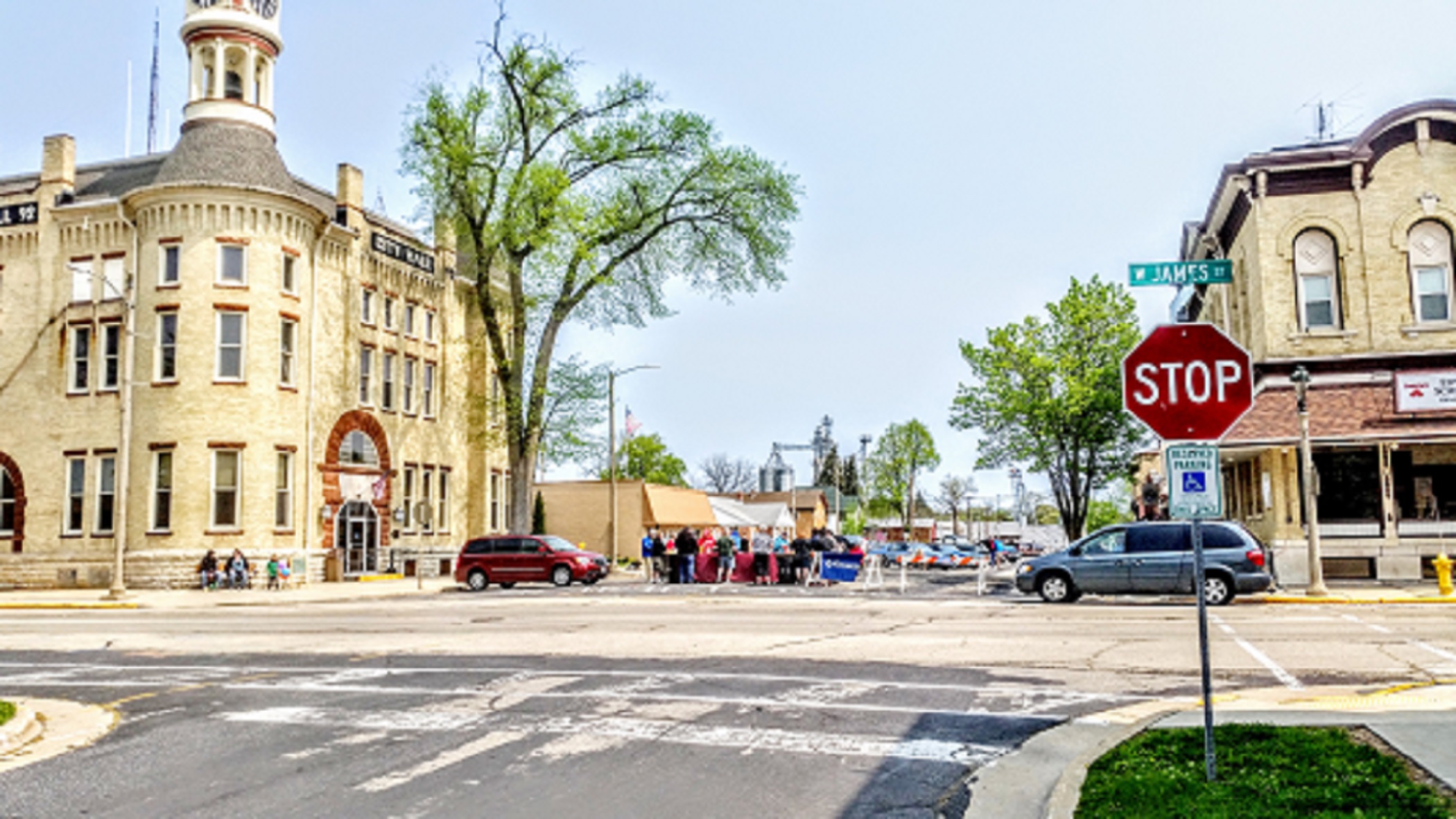
The reason to care, if you own a house here, is that Columbus has architecture people travel to see. The Farmers and Merchants Union Bank was designed by Louis Sullivan in 1919–20 — one of the small group of Prairie School “jewel box” banks he built late in his career, and a nationally recognized landmark. The Whitney Hotel dates from 1858 and the railroad depot from 1906. Downtown Columbus was convincing enough as a period street that it stood in for a bank robbery in Michael Mann’s Public Enemies in 2009. Every May the Redbud Festival crowns a prince and princess and celebrates a locally developed strain of redbud tree.
What that means for roofs is that Columbus has a real concentration of Victorian and early-century housing: steep pitches, towers, cross-gables, dormers, decorative ridge detail, and roofs originally covered in slate or wood shake. Almost every one of them has been re-covered in asphalt at some point in the last seventy years, and the quality of that re-cover is the single biggest variable in the condition of the roof today.
Done well, asphalt on a steep Victorian lasts a long time, because the pitch sheds water fast and nothing sits. Done badly — original flashing left in place, valleys woven with shingle instead of lined with metal, ventilation ignored entirely because the house never had any — and the water goes into a hundred-year-old structure where it is expensive and slow to find. We have opened up valleys on houses in this town and found three generations of patching underneath.
The other thing worth knowing is that Columbus is the quietest town on our list for hail, and one of the windiest. Only 11 recorded storms since 2005 — the fewest anywhere we work — and the largest hailstone ever measured here is a single one inch stone in November 2022. Sitting at the northern edge of the corridor, Columbus catches systems that have already crossed Dodge County and spent most of their hail.
What they have not spent is wind. 9 of those 11 events are straight-line wind, and on July 13, 2015 a 100 mile an hour gust was recorded here — the strongest reading at any town in our service area. In 2008 it was 84 miles an hour. So the risk profile in Columbus is unusual and specific: your roof is unlikely to be ended by hail and quite likely to be tested at the edges by wind, which on a steep Victorian with original flashing and a hundred-year-old ridge is exactly where it is most vulnerable.
Storm History
The Quietest Storm Record We Have
A short record, and worth reading for what is in it rather than how long it is. The hail here has been negligible. The wind has not.
11 recorded storms since 2005 · largest hail 1″ · strongest gust 100 mph · NOAA
-
April 13, 2026
Straight-line wind
Full record →A line of strong to severe storms developed over central Wisconsin as warm, moist and unstable air aloft surged into the region. The line of storms then moved southeast across southern Wisconsin. Widespread wind damage occurred across much of south central to southeast Wisconsin, with two tornadoes documented along with the high winds.
-
May 21, 2024
Straight-line wind
Full record →Lines and clusters of severe thunderstorms moved across southern WI from the late morning through the late evening as the passage of a warm front was quickly followed by a cold front. Straight-line winds accounted for fairly widespread tree limb damage especially over south central WI. Several reports of large hail were received while street…
-
November 4, 2022
Hail
Full record →Scattered thunderstorms along a slow moving cold front produced large hail over portions of southern WI during the afternoon.
-
June 15, 2022
Straight-line wind
Full record →A severe squall line formed along a surface trough and brought numerous swaths of wind damage to southern WI. Tree damage was prevalent and some structural damage occurred. The line of storms also slowed down, causing sporadic street flooding. Two home fires occurred after being struck by lightning.
-
June 5, 2016
Straight-line wind
Full record →Clusters of strong to severe thunderstorms produced areas of straight line wind damage in southern WI as a cold front was passing through the region. WE Energies approximated 20,000 customers were without power for at least a brief period across southeast WI.
-
July 13, 2015
Straight-line wind
Full record →The approach of a warm front and shortwave trough triggered a long line of severe thunderstorms in the form of a bow echo that moved across southern WI. Significant wind damage occurred in some areas.
Permits
Do You Need A Roofing Permit In Columbus?
No. The City of Columbus publishes that a re-roof needs no permit: “Building Permits are not required for siding replacement, window repair or replacement, or roofing tear off and replacement.” — City of Columbus — Building Permits and Inspection Requests. Siding is exempt on the same list, and same-size windows and doors too. We check the parcel before quoting, because a mailing address does not tell you which jurisdiction you are in.
No permit does not mean no rules: SPS 320.04(2) makes the work comply with the state code whether or not anyone inspects it. If a quote carries a permit line for a straight re-roof here, ask to see the permit. Anything unusual — a change of pitch, structural work, a dumpster in the street — is a phone call to the building department.
Older Homes
What Historic Roofs Actually Need
Metal-lined valleys
Not shingle-woven. On a steep multi-gable roof the valleys carry enormous volumes of water and they are the first thing to fail.
Step flashing, replaced
At every wall and chimney. Caulk over hundred-year-old flashing is a repair with a two-year life.
Ventilation, retrofitted
These houses were built without it. Adding intake and exhaust without wrecking the appearance takes some thought.
Decking assessment
Board sheathing rather than plywood. It needs checking for spread, rot and previous patching before anything goes over it.
Respect for the detail
Ridge lines, exposed rafter tails and decorative trim are why the house looks like it does. They come back the way they went.
Honest staging costs
A steep, tall, cut-up roof needs proper access. Anyone pricing it like a walkable ranch has not been up there.
The Quiet Advantage
Planning A Replacement Instead Of Reacting To One
Because Columbus is the quietest town we cover for severe weather, most roofs here reach the end of their lives on schedule rather than being ended by a storm. That is a genuinely better position to be in, and it is worth using.
A storm replacement is decided by an adjuster’s schedule, a supplement negotiation and whichever contractor has capacity in the two weeks after a regional event. A planned replacement is decided by you. You can get three quotes without a tarp on the roof, choose your material rather than accept what is in stock, book the work for a dry stretch in the spring, and pay for it out of a budget rather than a scramble.
The way to get there is to find out where you stand about three years before you need to. On a Columbus house that generally means an inspection somewhere around year seventeen or eighteen of the current roof, which tells you whether you are looking at two years or six. We will put that in writing, and if the answer is that you have six, that is what the report says.
On the older houses near the downtown there is a second reason not to leave it. A steep, tall, cut-up Victorian roof needs proper access — staging rather than ladders — and it is genuinely more work than a modern roof. Contractors who can do that well are not sitting idle, and the good windows in the calendar get taken early. Deciding in March that you would like it done in June is a very different conversation from deciding in October that it has to be done before the snow.
None of which is an argument for doing it sooner than you need to. It is an argument for knowing.
Straight Answers
Columbus Roofing Questions
Regularly, and it is a different job from a modern roof. The parts that matter are the valleys, the flashing and the decking underneath rather than which shingle goes on top. We walk you through what we find with photographs rather than describing it.
Broadly yes. Modern architectural shingle in the right color reads convincingly on a Victorian, and ridge and rake detail can be reproduced. What we will not do is pretend asphalt is slate — if you want slate or synthetic slate that is a different specification and price, and we will tell you honestly whether the structure can carry the weight.
Quite possibly more than one, and it changes the price. We check at the eaves and around penetrations before quoting. Two layers roughly doubles the tear-off labor and the disposal, so neither of us wants it discovered on the morning of the job.
It changes the likely reason you are calling. With only 11 recorded storms since 2005 and no hail above one inch, a Columbus roof is usually an end-of-life replacement rather than a storm claim — which means you can plan it instead of reacting to it.
Wind is the exception, and it is a real one. A 100 mile an hour gust was recorded here on July 13, 2015, the strongest at any town we serve. That kind of event does not wear a roof out, it takes pieces off it, and the damage is at the ridge, the rakes and the flashing rather than across the field.
No. Columbus is inside the radius we service properly. That is the honest limit worth asking any contractor about.
If your house is in the downtown historic district or is a contributing property, changes to material or color may need review. We will raise it before you commit to anything, and we have worked to that kind of requirement before.
It needs staging and fall protection rather than ladders, which is a real cost and belongs in the estimate honestly. A contractor pricing a tall steep cut-up roof at the same rate as a walkable ranch either has not seen it or is planning to cut a corner somewhere.
Free Inspection
Historic Columbus Roof?
Free inspection with photographs, and an honest assessment of what is under the shingles.